
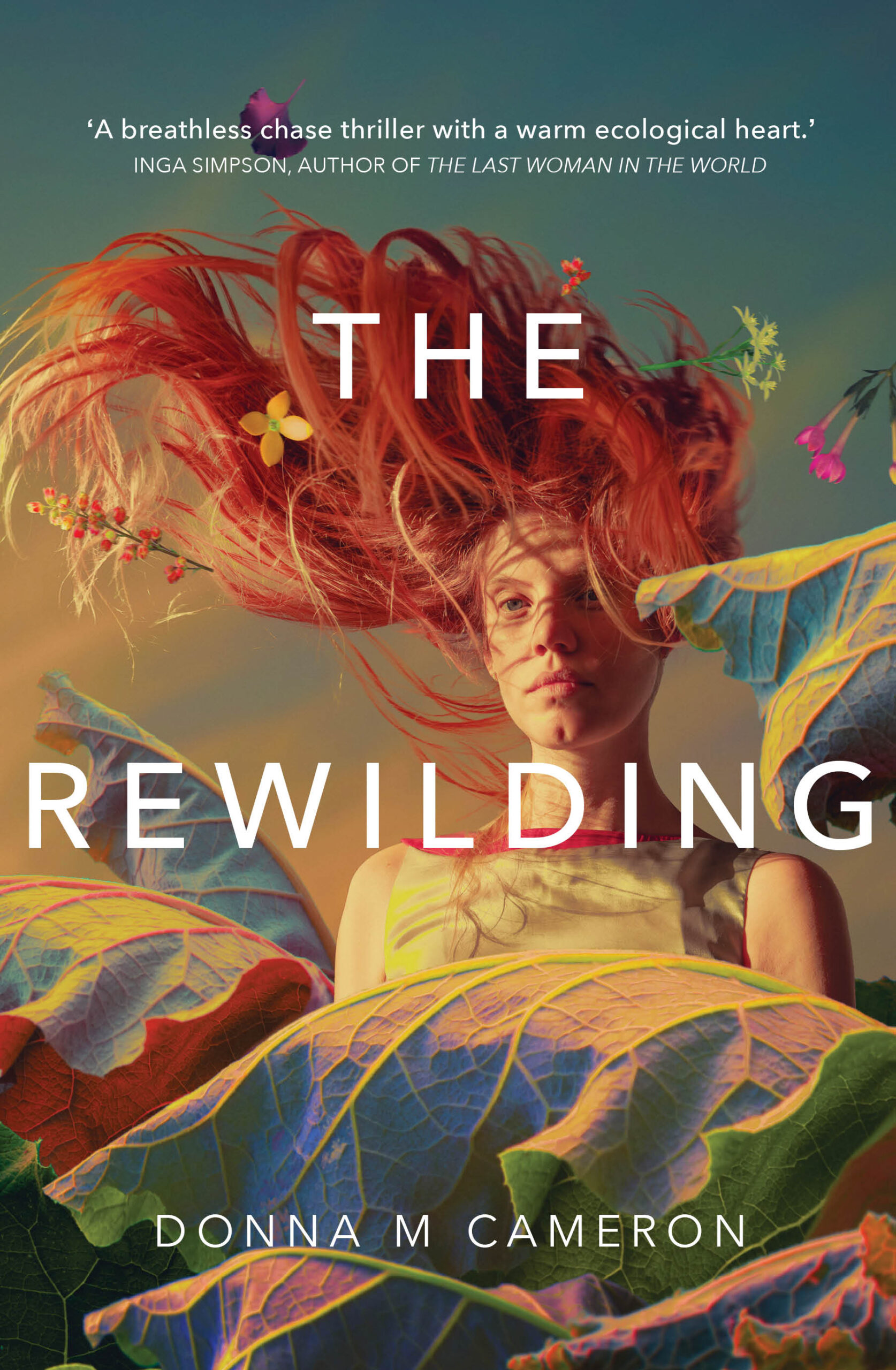
Review of ‘The Rewilding’ by Donna M Cameron
Cameron, Donna M. The Rewilding. Yarraville: Transit Lounge, 2024.
RRP: $32.99, 320pp, ISBN: 9781923023062.
Rachel Watts
‘Lately the thought sneaks up on me and pulls me under, and I can’t deny it: nothing we do now will make a difference—we’ve missed our chance.’ She is speaking so quietly he needs to strain to hear. ‘Too dumb, too selfish for too long.’ (208)
At the close of Donna M Cameron’s The Rewilding, the character Nia writes to whistleblower Jagger, lovingly and wryly telling him ‘I look forward to fighting with you by my side again, you hope punk’ (291). This balance between fighting and hoping is the central tension in the novel, with an immense cast of minor characters allowing Cameron to show the variety of ways hope and determination are held in balance, or how people succumb to the lure of one or the other. The novel portrays a world on the edge, a world of last chances, and the countless opportunities that are still worth fighting for.
Jagger has blown the whistle on greenwashing in his father’s construction company, emailed the evidence to every news outlet in town, and ran. He flees the city, stealing his friend’s bike and bug-out bag, and takes up residence in a cave in a national park near the beach, a place he remembers fondly from his childhood visits with his mother.
His mum claimed once that the sea will eventually drown this suburb built on a dune, but surely not when pelicans circle overhead, playing in the thermal updraft, and jacaranda flowers float past on the breeze. He’s out of the city, and the air smells like Violet Crumble popped fresh from the vending machine. He could eat the day. (19)
But Jagger isn’t alone in the cave. A strange woman appears, reminiscent of the Huldra, the Lady of the Forest his mother would tell stories of, and her first act is to steal all of Jagger’s money. This woman is Nia, cantankerous, secretive and wanting nothing to do with Jagger.
‘“You get off on wildflowers,” her smile is sadistic. “And lizards—trying to make friends with that skink, weren’t you. Feeding it, talking to it like your best mate. Not the usual suit-wearing type, are you?”’(53)
But their fates become intertwined when a hitman discovers Jagger’s hideout, both must flee, and Jagger becomes dependent on Nia and the assortment of environmental activists, homesteaders and survivalists she moves among. Nia is despondent, desperate, and grieving. But in time she and Jagger start to see each other’s worlds and the shared things they care about.
It is immensely difficult to tell stories about climate change. Realist fiction in particular is challenged by time, scale and the catastrophic impact of climate change, the ‘weird weirdness’ that Timothy Morton describes as part of ecological awareness (Morton 5). Things are getting weird and doing so in a multitude of ways that are difficult to articulate. But Cameron seems unbothered by global and temporal scale and does not engage with the ‘weird’ or looping forms that many climate writers engage in, instead offering a direct, linear narrative and incorporating difference among a range of fictional lives and symbolic gestures. The novel explores the intimate responses of her characters to the emotional and practical challenges they face in coming to terms with, resisting and adapting to a world in peril. Cameron works through Jagger’s memories of exploring the bush as a child, sketching and identifying plants with his mother, to build a contrast with his privileged adult years. The maintenance of hope is the thread that runs through his story, something his mother urged on him before she died. But there is a fine line between hope and denial, which Cameron evokes through the fraught nature of Jagger’s whistleblowing status—his signature was at the bottom of the incriminating documents, after all. By contrast, Nia’s character shows activism springing from a well of deep grief, thematically linking the character’s personal grief with a broader, amorphous grief at the destruction of the world. Bringing two opposed worldviews together, in the close environs of a tense road-trip, allows the resentment, complexity and desperation they share to come to the fore. They are only two people, but they are a representation of climate change attitudes in microcosm, and their developing fondness is a meeting of pessimism and optimism, of world-weariness and enthusiastic embrace. Their conversations reveal that neither of them is entirely correct in their assessment of the state of the world, but neither is entirely wrong either. And the same is likely true of all of us.
‘Maybe the question to ask then is—why be scared of change?’
‘I’m not scared, just sad for the last of our blue-sky days. Suck them up and never forget, that’s what I say. Nice while it lasted.’
‘You don’t really believe that, do you?’
The question hangs in the stars as the black stench of destruction creeps down from the miles of broken lives behind them. (211–212)
In simple but evocative prose, and with a breakneck pace, Cameron creates a road-story, an adventure, and a story of fighting against power in defence of kinder ways of living. Instead of exploring ontological implications of climate change through fragmented or unsettled structure, The Rewilding allows competing world views to meet and converse. In this simple act, perceived social conflict points evaporate, the characters come to see their struggles as linked and begin to view each other with compassion. It doesn’t solve problems, but it does accept them, and in doing so creates an open, even optimistic, space. Perhaps, then, this is an expression of Morton’s dark ecology—a darkness that goes beyond nihilism to ‘the sweet one’, the place of uncanny that is crucial to ecological awareness (5). To be wild, it seems, requires both awareness of the desperation of our times, and the courage to hope, and fight, for change.
Work Cited
Morton, Timothy. Dark Ecology: for a logic of future coexistence. Columbia University Press, 2016.Rachel Watts is a PhD candidate in creative writing focusing on narrative complexity in ecological and climate change fiction. Her writing has been published Westerly, Island, Kill Your Darlings, The Big Issue among others. She lives and works on Whadjuk Noongar Boodja.
Rachel Watts is a PhD candidate in creative writing focusing on narrative complexity in ecological and climate change fiction. Her writing has been published Westerly, Island, Kill Your Darlings, The Big Issue among others. She lives and works on Whadjuk Noongar Boodja.
Partners