
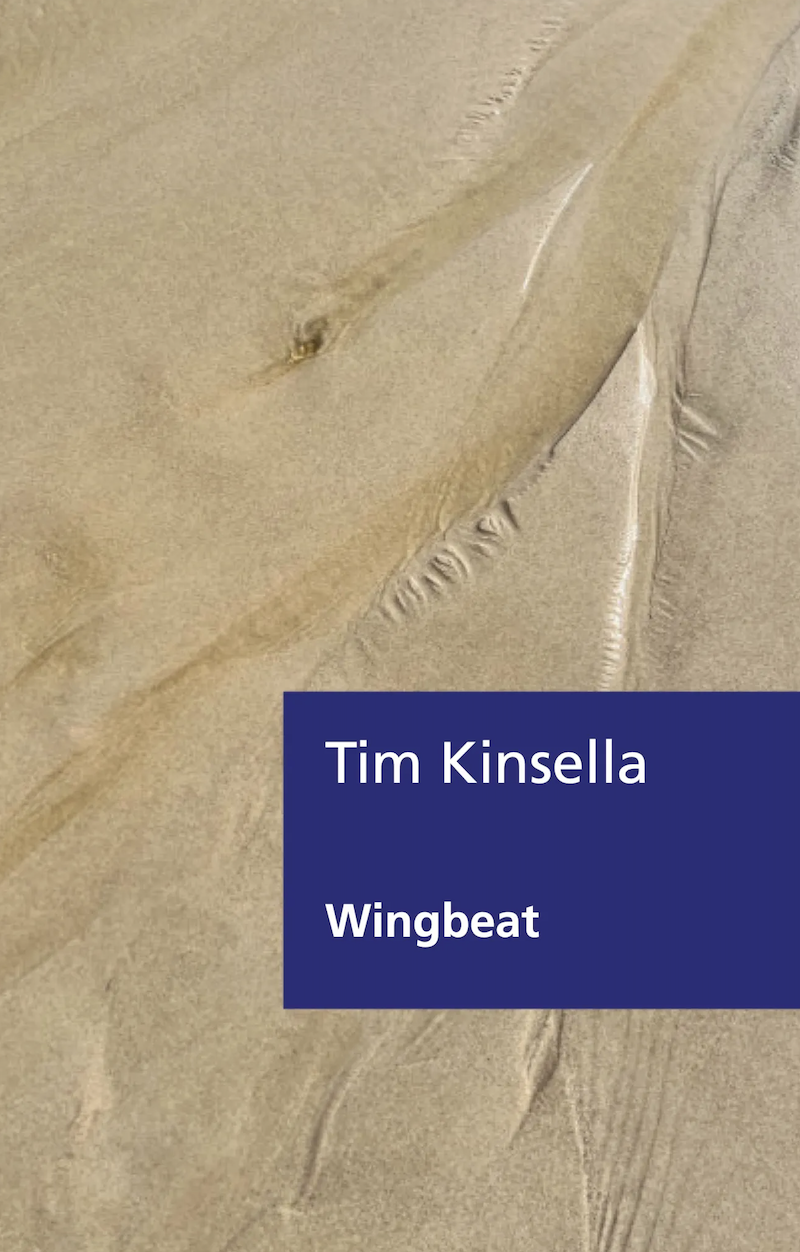
Review of ‘Wingbeat’ by Tim Kinsella
Siobhan Hodge
Kinsella, Tim. Wingbeat. Perth: WA Poets Publishing, 2024. RRP: $30, pp 88, ISBN: 9781923100022.
Tim Kinsella’s first poetry collection traverses multiple landscapes—natural/human-influenced spaces and different countries alike—with sensitivity and sharpness. There is no single poem titled ‘Wingbeat’; rather, each piece is a movement, a snapshot and point of engagement. In many ways, the collection feels a lot like a photo album; many of the poems are framed as pithy encounters and observations, with an occasionally wry undertone. Kinsella’s poetic speaker is predominantly in motion, taking nothing from the environment but snapshots, while savouring the opportunity to question different dynamics at play.
In Kinsella’s own words in the book’s introduction, Wingbeat is not ‘a book of bird poems’ (viii), but there is certainly no shortage of birds thriving amongst the pages (I have Kinsella to thank for learning the names of so many new types of bird!). The collection’s second section, ‘Plumage’, is supported by bird photographs by Wendy Kinsella, Kinsella’s grandmother, with both creatives sensitively capturing portraits of different birds. These pieces operate as untitled ekphrastic works, delicately sketching moments in the birds’ lives. Alongside these richly varied lives are also explorations of the natural environment, including a suite of poems set while climbing Walwalinj—a mountain in York, Western Australia. Howard Taylor’s art is another frequent refrain across the collection, with David Lynch and Andy Warhol also making appearances.
Stylistically, Kinsella’s poems could be perceived as imagistic, showcasing precise moments in bright detail; Kinsella also credits Classical Chinese poetry as a major source of inspiration. Du Fu (712–770) immediately appears in the collection’s opening poem ‘Dolphin & Night Heron’, and while Du Fu’s ‘clenched fist’ refers to roosting white egrets, here we have a nankeen night heron, roosting by day rather than the moonlit night (2). The human presence acting on the scene in Du Fu’s ‘Brimming Water’ is notably absent. Kinsella’s parallel reflections in this poem are reserved, letting the wildlife shape the scene, in keeping with the opening section’s root focus on birdwatching.
While the poems in Wingbeat tend towards sharp, imagery-intensive pieces, the poet also engages with longer forms, including more lyrical pieces, looping in cyclic rhyme schemes. ‘The Wheatbins’ is one example, imparting a looming, ominous impact in the process:
Refrain is the poetic quality in this landscape
& we can’t tell whether it’s new or a residue
in this region, a place always changing shape.
They tower over us now that we’re passing through
& we can’t tell whether it’s new or a residue.
The colours change in sky & structure’s exterior—
they tower over us now as we’re passing through.
Locals have painted murals to break off from the interior—  (51)
Silos effectively ‘take over’ the poem halfway through, tightening the form into repeated rhymes and lines, just as they visually dominate the landscape the speaker travels through:
We don’t need to look any further for evidence of the surreal
in these great silos. They are punctuated by murals—
sketches of psychedelia, illusions of the land’s vastness.
We don’t need to look any further for evidence of the surreal—
all lumped together are projections of eyes, hands & masts (51)
The final, chilling line—‘Listen! The murals are talking. The wheat is talking. There is no other sound’ (51)—echoes recurring questions in Kinsella’s poems: who may speak? who is being observed? which powers are at play? Similar tensions appear in ‘Bullet Holes’, a piece composed of rigidly rhyming, cyclic couplets in a linked examination of gun violence, degradation and the control of the natural world, and threats to life, both animal and human.
The ability to speak or be heard is another recurring theme in many of Kinsella’s poems. In the collection’s final work, ‘A Dream of Waterbirds’, the human speaker comes through more strongly, offering a more optimistic note, albeit with caution, with ‘that white-necked heron flying / over the slope once paddock now tree’d’, speaking of restoration of the land to a more natural state (84). There is a blurring of ‘his own / injured body & scarred face / their beaks & feet below the water’s surface’, yet the speaker admits that they are ‘unnamed only to an extent’ (84). Speaker and bird are both observers reflecting, caught in this optimism for healing and restoration of the natural world. In another poem, ‘Four Walks: Tübingen’, Kinsella’s poetic speaker explores intersecting points between human/animal and forest/suburb, recognising moments of blur, as in the second section:
2.

This staircase where
various elsewheres congregate
mediates—it’s a zone in between
tower & sandpit
eyed by pigeons & blackbirds
gargoyles upon a scape of grey & beige
suburban unravelling. (80)
The final part of this poem catches my eye, not least because it mentions horses, but primarily because it is the first where Kinsella’s speaker actively appears in the poem, foregrounding his keen eye for the points in which humanity and the natural world intersect. The layers of communication between woman/dog/horse/human bystanders are rigidly bound, unshifting as the speaker watches:
4.

In the forest, a woman
rides a horse that trots
& walks a dog that barks & leaps;
their communication is
vague. The woman takes
no notice. The dog exclaims & jumps
higher. The horse doesn’t deviate.
People walk by & the dog’s
focus shifts. I watch
from a distance, not wanting
anyone but the horse to see me.
The path I’m standing on
turns to mud & then to field. (81)
While the reference to wanting the horse to see the speaker may be a wry nod to not wanting to spook the animal, it also recognises the absence of communication taking place between woman and horse, and seems to invite connection. ‘Four Walks: Tübingen’ recognises the potential for change in communication strategies and levels of interaction between humans and the natural world, while also exposing their limits. The space is transformed from forest—a potentially wild space—to mud, a more ambiguous terrain—to a field, a space cordoned and limited by humans.
Tim Kinsella’s first collection is a rich journey through the natural world, sensitively achieved, full of memorable imagery and paired with sharp queries. Its strengths lie in its stylistic variety and respectful examinations of birds, landscapes and artworks, and also in acknowledgments of where there remain gaps in communication. The final lines of ‘Harbour & Castle’ are a fine summation of this anxious state:
Only at the top of
the tower am I able to see things clearly,
but not for one second

                                                   do I assume I have grasped them. (44)
The desire to try, however, is what makes this collection with its veritable narrative of ‘common ground’ (‘The Encroaching Mast’ 46) a delight to read and a bright promise of much more to come. Kinsella’s poetics of observation and question are frequently quiet, personal and episodic, but just as often recognise the blurred lines and boundaries of the world, and the broader politics of crossings.
Siobhan Hodge has a Ph.D. in English literature. Her thesis examined the creative and critical legacy of the ancient Greek poet Sappho. She was winner of the 2017 Kalang Eco-Poetry Award, joint winner of the 2015 Patricia Hackett Prize, and was shortlisted for the 2019 Fair Australia Prize. Her work has been published in numerous places, including Overland, Westerly, Southerly, Cordite, Plumwood Mountain, Peril, and the Fremantle Press Anthology of WA Poetry. Her chapbook, Justice for Romeo, is available through Cordite Books.
Partners