Review of ‘Naag Mountain’ by Manisha Anjali
Nadia Rhook
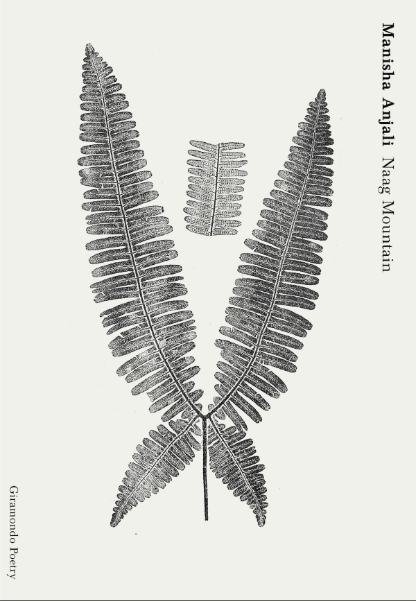
Anjali, Manisha. Naag Mountain. Penrith: Giramondo Publishing, 2024. RRP: $27.00, 112pp, ISBN: 9781925818994.
Naag Mountain is an enthralling work of intergenerational story-making and reclamation. Poet and artist Manisha Anjali draws on methods of oceans and of dreams to repair the violence of coerced labour by the loving freedoms of collective imagination. In this carefully mystifying text, readers are called to follow Anjali beyond the formal(ised) borders of nation-states into the spirited ways of liquid; the cloud-becoming-ocean transformations of water.
Names of seas are fictitious. The sea does not need to prove its autonomy. There is no beginning. There is no end. Water takes the shape of whomever they love. (92)
Sharing evident synergies with Tongan anthropologist Epeli H’auofa’s articulation of ‘the ocean as method’1, Anjali’s writing is as seamlessly poetic as historical as methodical. Geographic imaginaries are formed through and across the Pacific Ocean and its more-than-mythical myths. Culturally sovereign, re-spun ancestral (hi)stories variously evade, dissolve and drill away colonial stories.
To dissolve the distance between dream and propaganda, I drill a hole in my skull. (8)
Colonisation in the Australia-Pacific region and beyond has long been a cosmological project. Its practices of property-making and land and resource extraction are enabled by a stifled sense of the cosmos, for settlers (my loved ones included) are asked to treat land as less than it is—as material rather than spiritual and alive. In her thesis ‘The Right to Dream’, Goenpul, Yagerabul, Minjungbul, Bundjalung, South Sea Islander scholar and storyteller Romaine Moreton writes:
Invasion and colonization imported western consciousness and concepts to the land now known as Australia. Through the advent of western language, the cosmology of Indigenous folk was to collapse beneath the weight of colonial lexical baggage; and the view that the land was a thing rather than a being is the basis of emergent colonial narrative. (199)
At every line and page, Anjali keeps a potentially (re)colonising sense of history at bay, revealing colonial archives and stories to be but drops in the text’s multi-dimension world. The land and water-base of colonialism is expanded through the poet’s relationship with what might be called the metaphysical, or what might be experienced as a realer reality. Anjali invokes the agencies of spirits and beings, such as the titular naag, a thousand-mouthed snake; beings that British colonialism—with its many and varied efforts to cast non-Anglo-Protestant spirituality as superstition—clearly never succeeded in reducing.
A message from the moon. I am moving at 10,000,000,000,000,000,000,000,000 revolutions per minute. When you see me I’ll be out of print. (34)
The result is a decolonised historical truth both implicitly and transparently rendered. Within this book, a film of archives called Paradise Paradise washes up on shore. ‘Are these archives real?!’, I wondered at first read. Then, as Anjali continues to hold a light up to the specious differences between history and myth, I register the coloniality in my curiosity. Obsessions with the line between fiction and nonfiction can be border-making exercises. In a determination to pinpoint a definitive truth, a reader/I might unwittingly impede the life and flow of history.
The smell of kerosene and clove awakens our cellular memory. Our hearts beat against the green current. We find the oldest book in the pocket of our uncle’s denim jacket. There are seeds inside. We read the seeds and we witness the falling of the colony and our names, passports and flags fall with it. (48)
While the ocean in Naag Mountain is a borderless being, it is also evoked as a site that has seen specific historical displacements and separations of family and community, including Anjali’s Indian ancestors who were indentured work on Australian-owned plantations in Fiji. Between 1863 and 1904, Anjali tells, ‘over 62,0000 South Sea Islanders […] were taken to Australia for sugar and cotton labour. Many were abducted, forced, trafficked’ (66). Indentured labour, I learnt from the teachings and family history of the beloved Fijian Australian historian Tracey Banivanua-Mar, was a much less famous global system than slavery, but similarly exploitative and abusive. European colonisers fought for the moral superiority of being the first to outlaw slavery. And yet, indentured labour was very like slavery. Ancestors of labourers and historians alike agree that the legal trick of the contract—what Anjali describes as ‘the haunted “agreement”’ (25)—allowed for labour exploitation to continue under a new name and new laws. Written from the subject-position of a poet who directly inherits this history, the possessive practices of the Colonial Sugar Refining Company (CSR)—the sugar company that, Anjali writes, ‘once owned my family’ (9)—feel newly violent.
When taking a break from writing this review, an ad for CSR appears on my laptop. I become conscious that, at the very same time as I’m in the world of Naag Mountain, millions of people are eating refined sugar produced by companies yet to recompense or confront their exploitative violence. In 2021, CSR had ‘over 3,000 employees and reported an after-tax profit of $146 million’2. Consciousness-blinkering ads playing on repeat or not, Anjali’s thriving relationship with the ocean ensures that nothing about sugar’s production is forgotten:
The naag disseminates a creation story that has been fractured, manipulated and half-forgotten. The ocean remembers the original version of the story. The ocean remembers every time it is touched. (7)
The lightly-threaded prose of Naag Mountain carries enormous amounts of the past; enormous not only in the spatial sense of what might be called Asia-Pacific and Australasian geographies, but also in embracing lots of sub- and (un)consciousnesses. Anjali is generous in creating space for others to enter deeper into dreams. She is the founder of the Neptune Archive, a research and documentation platform for dreams, visions and hallucinations, and runs ‘The School of Dreams’—workshops ‘rooted in the idea that the artist must perform between two realms—the dream realm and the waking realm.’ Dreams, as historian Samia Khatun has written in her work on South Asian odysseys in so-called Australia, are not outside of history, even if institutional history conventionally places dreams as epistemic outcasts.3 Anjali is a professional interpreter and archiver of dreams, and in Naag Mountain she both spells out and realises a dream method that poets, creative practitioners, genealogists, healers, cultural theorists and historians all might learn from. Indeed, this poetry raises profound questions about history’s epistemic and ontological boundaries. Where is history? In which (dis)connected dimensions? Which temporalities and spiritual realities are bracketed out of history, and which invited to the body-soul, the page? And what kinds of labour does it entail to live through the knowledge paradigms of your ancestors? Anjali writes:
When a story is shared by mouth, the story is never the same, it changes the way it wants to, and every version is true. We pull the propaganda instruments out of our throats. We hang our mother’s singing shellfish from our ears.
Such methods of receiving and knowing history extend into ways of ethical living.
Imagination is a political tool designed to keep us in love. It is our responsibility to always be in love. (51)
Naag Mountain cleaves spaces between the material and archival registers of historical knowing that colonialism produced. At moments, we’re jerked out of a dream-state to wake to a possessive, profitable and enduring CSR Company devastatingly and disgustingly ‘real’.
We cut a circle in the watery mythology. This is how we cut time in half. The Colonial Sugar Refinery Company planted our bloodlines in the great southern waters. This is how our tea and biscuits become sweet on red Australian afternoons. (17)
The truth at stake here, it seems, is less about a set of facts and more truth as ontological realm. What of consciousness, which beings, can we, do we, allow to thrive in poetry?
Naag Mountain is a collection that beats in the heart of changing nothing less vital than a reader’s sense of how things connect and collaborate and speak with each other. This is poetry that expands the possibilities of transmitting history through the plantation-haunted, machine-manufactured fibre of a page to enliven the future. Anjali seems to suggest that transformation takes place at once in the text and in interlinked dimensions beyond it; dimensions where inherited pain—and freedom from it—co-exist.
The flowering white jasmine tree cannot hold the violence of the translation, so she picks herself up and walks into the ocean. She plants her roots in the water so she can dream with the sea. (37)
In pouring this collection into a place where the poet and the ocean are inseparable, Anjali creates a timelessness to dream with.
1 See Hau’ofa’s essay ‘Our Sea of Islands’.
2 This is according to CSR’s Wikipedia entry: https://en.wikipedia.org/wiki/CSR_Limited.
3 See Khatun’s essay ‘The Book of Marriage: histories of Muslim women in twentieth-century Australia’.
Works Cited
Banivanua-Mar, Tracey. Violence and Colonial Dialogue: the Australian-Pacific indentured labor trade. University of Hawaii Press, 2006.
Hau’ofa, Epeli, ‘Our Sea of Islands’. The Contemporary Pacific, 6.1 (1994): 148–61.
Khatun, Samia. ‘The Book of Marriage: Histories of Muslim Women in Twentieth-Century Australia’, Gender & History, 29.1 (2017): 8–30.
Moreton, Romaine. The Right to Dream. Doctoral Thesis, University of Western Sydney, 2006. Sourced at: p. 199. https://researchers-admin.westernsydney.edu.au/ws/portalfiles/portal/94779651/uws_2495.pdf.
Nadia Rhook is a writer, historian and educator, currently living in Ballarat, on beautiful Wadawurrung Country. She’s the author of boots (UWA Publishing) and Second Fleet Baby (Fremantle Press). Her third poetry collection, Stone Veins, traces histories of bluestone mining, ecology and haunting, and will be released by Cordite Books in 2027.
Partners