
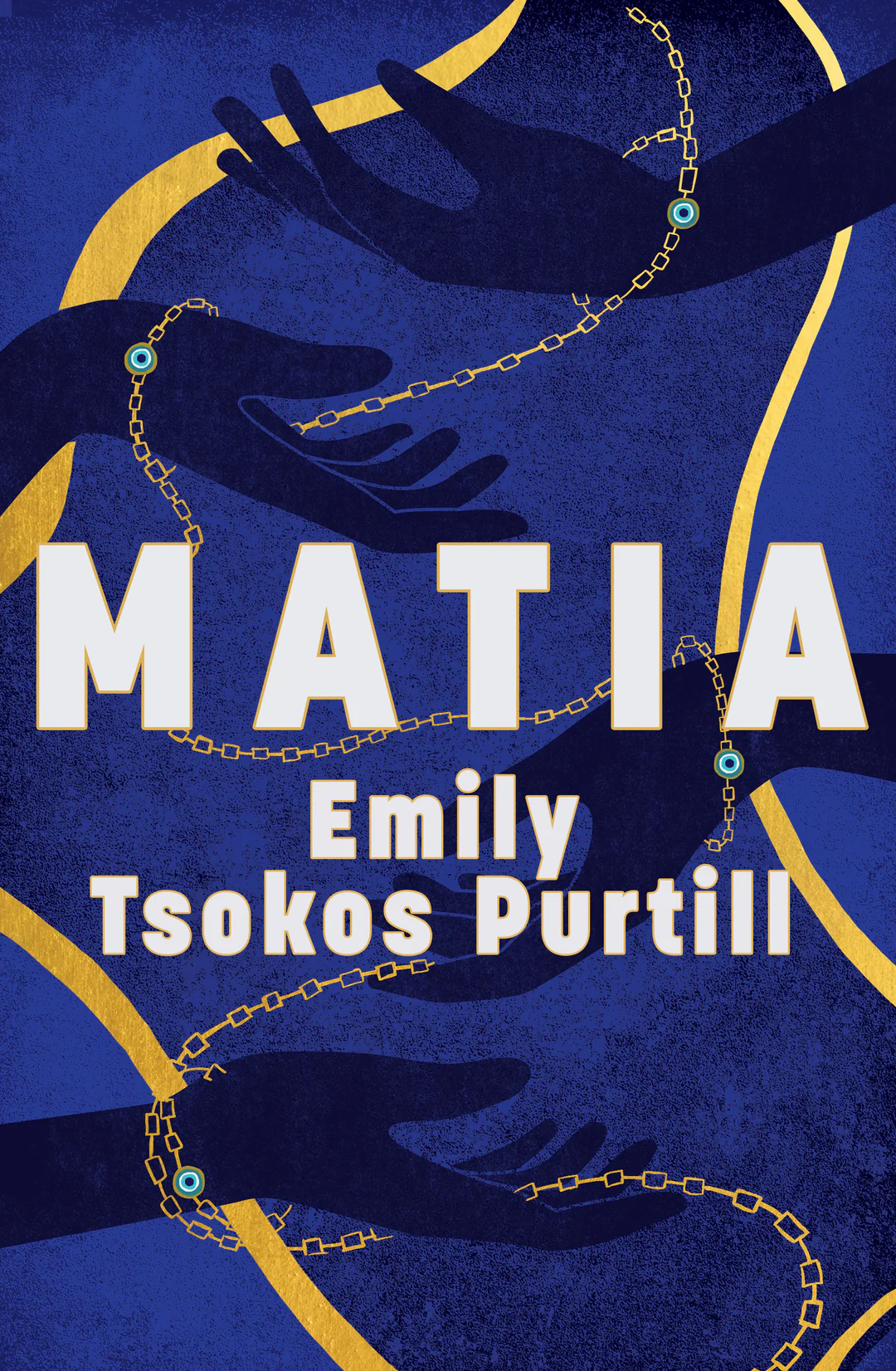
Review of ‘Matia’ by Emily Tsokos Purtill
Patricia Frazis
Tsokos Purtill, Emily. Matia. Crawley: UWA Publishing, 2024. RRP $34.99, 270pp, ISBN: 9781760802905.
Women in diasporic communities often bear the responsibility of maintaining traditions and culture. Matia, the debut novel from Emily Tsokos Purtill, closely considers the strain this maintenance can place on relationships, and even on one’s own identity. Tsokos Purtill’s book follows four generations of women as they immigrate from Greece to Perth to New York. Beginning in the middle, the narrative slowly unfolds in a non-linear fashion to reveal the complex relationships between mothers and daughters, with chapters told from the perspectives of each of the four protagonists: Sia (born in 1928), Koula (born in 1946), Athena (born in 1974) and Clara (born in 2010). Each woman bears a prophecy of their future and wears a Mati, a blue symbol passed down from mother to daughter to protect the wearer from the Evil Eye. As these prophecies blur the lines between the past and future, the novel demonstrates how family history—both known and hidden—still affects the present because of the way decisions ricochet through generations.
Alongside the maternal relationships at the core of the novel, those between female friends and sisters are foregrounded too, and each relationship explored within Matia encounters its own difficulties that are exacerbated and complicated by responsibilities to heritage. The vivid settings, from Perth’s hot, dry summers and (comparatively) temperate winters to the ever-changing deciduous trees of Central Park, provide more than just a scenic backdrop: they integrate themselves into an exploration of tradition and independence. Sia follows her father to Australia and finds Perth foreign and formidable, with sunlight ‘that wanted to kill you’ (42). But the true danger comes from her obligations to her family when she finds herself trapped in a violent marriage to a much older Greek man. To survive her new environment, Sia must exercise some agency within the boundaries of her community’s expectations. Meanwhile, her daughter Koula grows up in Perth and can’t imagine a life outside the Greek–Australian diaspora: even a holiday to Greece itself seems impossible. In Koula’s story, Tsokos Purtill navigates the cultural inheritance of second generation immigrants. Koula needs her ancestral homeland to remain distant and mythical so that she doesn’t have to confront the restrictive and outdated expectations within her community in Australia. And, much like her ‘secondhand [Greek] learnt from [her] mother’ (30), the foundations of Koula’s community and culture are built on a past that no longer exists but is ever present all the same.
These ideas are placed in conversation with Australian cultural insecurity. Athena later chafes against not only the Greek–Australian community, but also Australia at large. To Koula’s dismay, Athena moves to London then New York, chasing that elusive something that breeds literature and art; she says that Perth is only nice if you are ‘a beachy sporty person […] Not really a quiet Prufrock person’ (241). Athena raises Clara to be independent, and as a young adult, she works at the Met, allowing for extensive allusions to art, music and poetry throughout her and Athena’s chapters. But as the drastic North American seasons endlessly change around her, Clara is isolated and untethered, particularly following a death in the family. Even as a young adult, Clara fears she could become ‘one of those people who died and nobody knew about it for months […] [until] a strange smell came out of their apartment’ (207). The novel can only resolve when Clara discovers and acknowledges her own past, and the history and inheritance of each of the women who came before her.
There are moments in Matia when the narration feels slightly over-explained, but perhaps this is a symptom of my own familiarity with the community and archetypes in the book: I share a maternal Kastellorizian heritage with the author. Tsokos Purtill’s portrayal of complicated female relationships is authentic, and appears to be deeply rooted in lived experiences: particularly evocative of this, at least for me, were the critical maternal figures in the novel, and the often unsolicited advice of community members! It is a joy to see characters and turns of phrase that I have known since I was a child represented. The relationship between Koula and Athena is a personal favourite as it shows the consequences of failing to find a balance between cultures. Koula can be overbearing in the unique, passive-aggressive way of her generation of Greek–Australian women, but she is also deeply hurt by Athena’s absence and cannot understand her daughter’s apparent rejection of her way of life. It is with their relationship that the friction between resentment and love, expectation and disappointment and loyalty and independence is the clearest.
Thematically and structurally, Matia sits comfortably amongst other writing from the diaspora, including Christos Tsiolkas’ Dead Europe and Helen Koukoutsis’ collection of poetry Cicada Chimes—though perhaps without their political sting. Matia and Cicada Chimes are both non-linear, cyclical explorations of the tension between individuality and tradition in the Greek–Australian context. However, unlike Koukoutsis, Tsokos Purtill neglects any real consideration of religion and the role of the Greek Orthodox church in maintaining tradition, community and language, nor does she interrogate the contradictions between the patriarchal church and the matriarchal pagan superstitions we see in the novel. Matia’s main contribution is perhaps in the temporal scale of the novel. The transgenerational structure allows the novel to explore several existing themes from diasporic literature, such as dispossession, identity and cultural inheritance, with sufficient time and distance to see their impacts reverberate and resolve. In this way, the narrative diffuses the lingering impacts of the past, and as a result Tsokos Purtill shies away from interrogation into something a little more pre-destined and hopeful.
The relationships and conflicts in Matia will be recognisable to many readers and the novel is an example of how the specific can represent more universal experiences. Women carry the burden of cultural inheritance and the responsibility to maintain traditions in many diasporic communities and are also disproportionately burdened with the care of elderly family members as well as the physical and mental strain of bearing and raising children. Matia is a love letter to these women and their relationships to one another, which can be messy and painful but also beautiful.
Patricia Frazis is a writer based in Canberra currently undertaking a PhD in Creative Writing at the Australian National University. Her research is concerned with audiobooks and the ways that sound and text can interact to create meanings about place, culture and language. She is a Greek–Australian woman who has lived in several cities across Australia, New Zealand and Greece; she has been published in Publishing Research Quarterly.
Partners