Review of ‘Happy Together: bridging the Australia–China divide’ by David Walker, Li Yao and Karen Walker
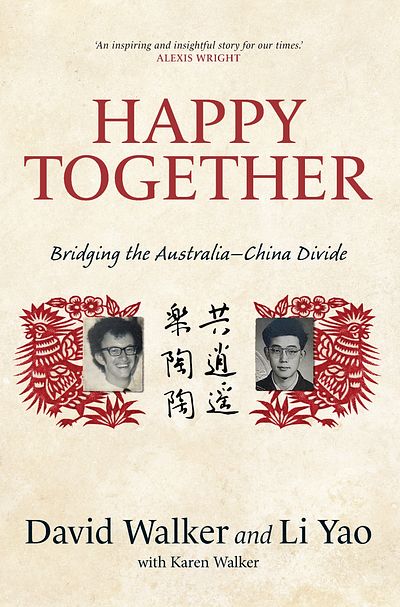
Walker, David, Li Yao and Karen Walker. Happy Together: bridging the Australia–China divide. Melbourne: Melbourne University Press, 2022.
RRP $34.99, 280 pp, ISBN 9780522878547.
Tiping Su
Happy Together: bridging the Australia–China divide is co-authored by the distinguished Australian historian David Walker, the senior Chinese translator of Australian literature Li Yao, and Karen Walker, whose dual position as scientific observer and emotional participant brings an additional dimension to this cross-cultural narrative. Through an interwoven dual family history, Chinese and Australian, the book traces the complex transformations of China across the past century and a half, combining memoir, cultural reflection and intellectual friendship to offer a distinctive perspective on Sino-Australian encounter. Drawing on interviews with writers, historians and cultural figures in both countries, alongside archival materials, newspapers, policy documents and family records, the authors situate individual lives within broader national histories and demonstrate the intimate entanglement of personal fate and geopolitical change.
The historical framework of the book unfolds across three major periods: the upheavals prior to 1949, the decades of radical transformation under Mao Zedong from 1949 to 1978, and the renewed cultural exchange that followed the end of the Cultural Revolution. This structure illuminates the long durée of instability, shaped by invasion, civil conflict, economic hardship and famine, that informs modern Chinese aspirations toward peace and continuity. Li Yao’s own family history exemplifies these pressures, including intellectual and landlord backgrounds rendered dangerous during revolutionary campaigns, separation from family, and the ever-present risk attached to speech and memory. Yet the same historical forces that produced trauma also enabled later literary and cultural connection. After 1978, Li’s work as a translator of Australian literature, including Henry Lawson and Patrick White, opened pathways of mutual recognition between Chinese and Australian readers and allowed translation itself to function as a form of historical repair.
The dual biography of Walker and Li is animated by coincidence as much as contrast. Born in the same year, the Year of the Rooster in the Chinese zodiac, the two men jokingly refer to themselves as ‘roosters’, a metaphor that comes to signify stubbornness, candour and persistence across divergent political and cultural conditions. Their childhoods diverge sharply, Li’s shaped by revolutionary persecution and material precarity, Walker’s by the constraints of a disciplined Australian household he later described as ‘annoying’. Yet these asymmetries ultimately generate connection rather than distance. Walker’s scholarly turn toward Asia and Li’s sustained engagement with Australian writing create a shared intellectual terrain in which communication becomes the ground of friendship. The Confucian principle of he er bu tong (和而不同), harmony without uniformity, quietly structures this relationship and offers a suggestive metaphor for the broader Australia–China dynamic: cooperation without ideological convergence, intimacy without sameness.
The book’s geographical focus on northern China invites comparison with Mary Gaunt’s early twentieth-century travel narrative A Woman in China, newly translated by Li Yao and frequently cited within Happy Together. Read together, the two texts juxtapose outsider observation and insider memory, travel writing and life writing, colonial curiosity and historical witness. This pairing deepens the reader’s understanding of the longue durée of suffering, including famine, foot-binding, migration and social upheaval, while also foregrounding the interpretive labour required to translate experience across time, language and political transformation. In this sense, translation emerges not merely as literary practice but as an ethical mode of historical mediation.
The strengths of the dual-biographical form are fully realised in the interplay between Walker’s wit and Li’s emotional directness, which together produce a textured portrait of everyday Chinese life shaped by resilience, kinship, education and mutual care, yet shadowed by feudal hierarchy, class violence and cultures of surveillance. Karen Walker’s presence as third author is therefore crucial. Her scientific training introduces documentary precision, while her personal participation, travelling, observing and commemorating, transforms parallel narratives into a shared field of perception. As a mediating consciousness between the two ‘roosters’, she provides structural balance and interpretive continuity, enabling the book to move beyond juxtaposition toward genuine dialogue.
Ultimately, Happy Together offers more than a record of friendship. It proposes a mode of cross-cultural understanding grounded in lived relation rather than abstraction, suggesting that historical trauma, political difference and geopolitical tension do not preclude intimacy but instead render it more necessary. For readers in Australia who may approach contemporary China through inherited suspicion or distance, the book provides a quietly persuasive counter-narrative, one in which personal connection, translation and shared memory become the fragile yet enduring grounds of mutual recognition.
Work Cited
Gaunt, Mary. A Woman in China. T. Werner Laurie, 1914.
Tiping Su is an Associate Professor at the School of English Studies, Xi’an International Studies University. He has published over thirty papers and authored two monographs, including The Bush Revisited: cultural identity in Australian literary writing (2024). He published his translation of Tony Birch’s The White Girl in 2026.
Partners