
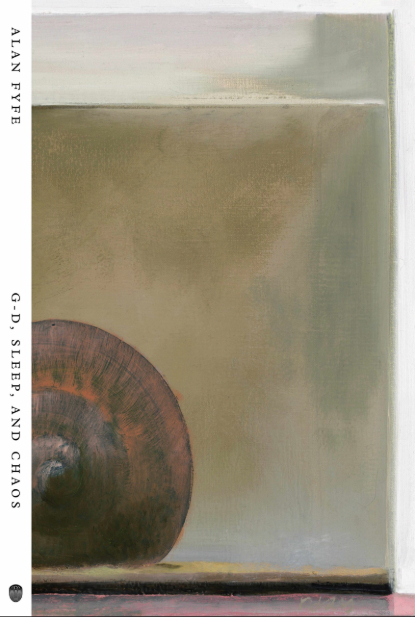
Review of ‘G-d, Sleep, and Chaos’ by Alan Fyfe
Talya Rubin
Fyfe, Alan. G-d, Sleep, and Chaos. Sydney: Gazebo Books, 2024. RRP: $29.99, 156pp, ISBN: 9780645920970.
Alan Fyfe’s debut poetry book, G-d, Sleep, and Chaos (Gazebo Books, 2024) was awarded silver for the Flying Islands Manuscript Prize for an unpublished collection, and it wouldn’t surprise me if it was headed for further accolades1. The language is lush, assured and transporting. Reading the book, designed with no table of contents and unnumbered pages, feels like passing through a series of fever dreams that mingle the surreal with the hyper real.
At times gritty and tongue-in-cheek, the poems about working class labour, drug addiction, grief and death are often contrasted with awe and spiritual grace. It is this balancing of opposites, this juggling of heaven and earth (with a touch of hell), that makes the collection vivid in its embodied navigation of the metaphysical. It is a dense, deeply considered book that explores the loneliness of being human in a world that has perhaps forgotten its g-ds. Or maybe, as in the poem, ‘Eurythphro Dilemma’, g-d is barefoot, hash smoking2, and internet-addicted, right here among us, waiting for the bus at Perth Central. A bus the all-knowing allows to be late. Even in his omnipotence, he makes room for the human: ‘the bus driver has her reasons’. Fyfe wrestles with the reverent and irreverent here with irony and delight:
         […]      The most-high nods his everywhere head. Silvery
dandruff floats to the pavement like manna. His phone rings.
The seraphim are calling. Their pay’s infinity late. He never
answers. (‘Eurythphro Dilemma’)
In Judaism, the ‘o’ is left out of ‘g-d’ when it is written down, as it is believed the word for the divine should not be desecrated, erased, or destroyed. This missing letter, this empty space, highlights the potency of the written word. In the Jewish faith, the everyday act of writing has enormous impact on the world, both human and divine.
Fyfe balances realms of the profound and mundane with weighty, carefully crafted language, absurdity, beauty, and a healthy dose of humour. Words themselves, just as in the religious tradition he comes from, are truly of consequence. He traverses loss, grief, addiction, and love with a deft hand, navigating the depths of human experience with the swagger of a cigarette-addicted sailor travelling the realms of the seraphim.
Grouped in seven sections ranging in form from monostich, prose poems, ekphrastic poetry, a calligram and a sardonic haiku called ‘Relationships’, the book feels sprawling. At times despairing, desperate, trauma-fuelled and drug induced, the reader comes away with the feeling that Fyfe is in love with this broken world and punching his way through it, even greeting death with exuberance. In ‘A Funeral in Pinjarra’ he celebrates his own departure with a mixture of devil-may-care attitude and the intimacy of fear:
Haul my half dead carcass to a teleconference,
so I can tell everyone I’m not afraid,
even though I’ve always been afraid.

Afterwards, lay the sequined shroud
and roll me through Pinjarra strapped
to a fibreglass cow with casters in its hooves.
The poem ‘After Pittsburgh’ is the beating heart of the collection, and Fyfe mentions in interviews that once its 128 words fell into place the entire work could come into being. It is written in remembrance of a mass shooting in 2018 at the L’Simcha synagogue in Pittsburgh, and is about absences, erasures, and finding light in darkness. The essence of the entire book is in some ways embodied in what this poem calls ‘lending phonics to the unseen’:
The missing vowel from G-d can’t show up in the light. That
O hums more in the spaces between the furniture and the wall.
In Judaism, grief is active. As Fyfe writes in the prologue to ‘After Pittsburgh’: ‘Their memory for a blessing’(italics in original). We keep alive the dead in their remembrance, just as the book keeps alive the subterranean world alongside the visible, the spiritual with the mundane. Writing becomes an action, a kind of activism of piecing the self together and joining impossible opposites.
‘Gilgul’, a concept that refers to the transmigration of human souls in Jewish mysticism, is a particularly beautiful example of a poem working on this twin level of the spiritual and the deeply human. ‘When I was a ghost, I was cold. I died in the red cotton pants / I slept in—no shirt (shlepping fat-bellied and exposed / all over some half and half afterlife).’ In ‘Two Visitation Dreams’ Fyfe lays out the duality of existence in mirror image poems that express opposites by shifting words and images slightly within a similar frame. In one poem there is an ‘antique sun’ and in the other ‘bones after blunt trauma’.
The minutia of the invisible is made visible throughout the collection, and things that normally go unnoticed become vivid and imbued with importance. In ‘The Bin Truck Said’ a garbage truck becomes the great leveller of humanity, the detritus and rejected made equally significant and communal. ‘And, whatever petty deity I’ve pissed off now / has made the bin truck whisper all my secrets to the street.’ The poem is bursting at the seams with onomatopoeic language, ‘Bow-bellied-behemoth snail barging,’ ‘click clack bin-lids / do staccato paragraphs on lost rat-food.’
Poems often bounce between a self-depreciating, absurdist sense of humour, and lush, deeply honed worlds. Direct language with singular questions or a slender piece with one word on each line tumbling down the page are interspersed with dense poems intense in their philosophical leanings and carefully crafted word choices.
The book is also jam-packed with cultural references. A soundtrack of hip hop, The Pogues, and Amy Winehouse thrums through the collection, and a tribute to the ghosts of poets past weave their way through as well: Bukowski, Baudelaire, Dickinson, Williams, McGonagall(!) and even Beowulf get a nod. Alongside these reference points, Fyfe sits comfortably within the experimental landscape of his poetry contemporaries in the Perth scene, such as Madison Godfrey, Lisa Collyer, and Scott Patrick-Mitchell, sharing seemingly casual yet deeply careful language, intense feeling, and true wrestling with human frailty.
G-d, Sleep, and Chaos is filled with both nihilism and hope. Many of the poems in the collection are infused with a kind of dark, bleak brutality that gives way to tenderness and light. The book is a gritty, ugly, beautiful love song to existence, a prayer to silence, and a call to arms against elitism and complacency, seeing the divine even in the gutter.
1	Since this review was written, G-d, Sleep, and Chaos won the Book of the Year and Poetry Book of the Year awards at the WA Premier’s Book Awards 2025, and it was Highly Commended for the Victorian Premier’s Literary Awards for Poetry in 2025.


2 	Regular visitor’s to the Editor’s Desk will know that Westerly’s house style forbids the Oxford comma. In recognition of its significance to G-d, Sleep, and Chaos, it is retained in this review.
Talya Rubin is a writer and performance maker living and working in Boorloo. She is the author of two collections of poetry, Leaving the Island (Vehicule Press, 2015) and Iceland is Melting and So Are You (Book*hug, 2021). She won the national Canadian Bronwen Wallace Award for the most promising poet under age 35 and has been longlisted for the Montreal International Poetry Prize and the CBC Poetry Prize. She runs a theatre company called Too Close to the Sun and has toured performance work to Arts House, PICA, Brisbane Powerhouse, Vitalstatistix, Performance Space and Brisbane Festival.
Partners