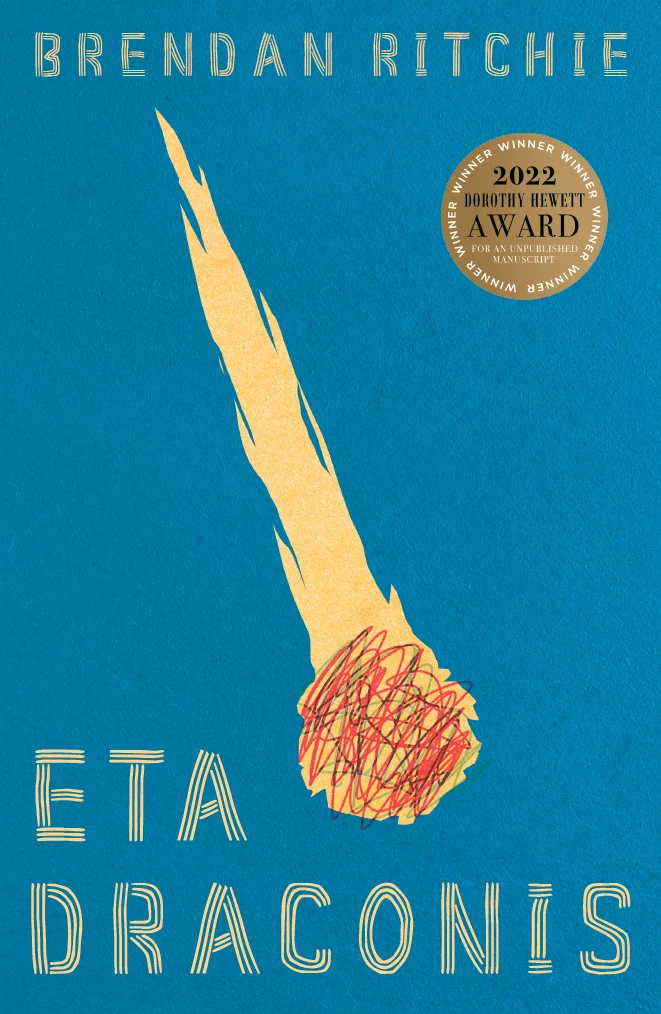
Review of ‘Eta Draconis’ by Brendan Ritchie
Jen Banyard
Ritchie, Brendan. Eta Draconis. Crawley: UWA Publishing, 2023. RRP: $32.99, 247pp, ISBN: 9781760802615.
Forget the hunk of space rocket that had us in a tizz when it washed up at Green Head near Perth in July 2023. In Eta Draconis, Brendan Ritchie’s third novel, our whole planet is being bombarded by meteorites cast by a dying star. Eta Draconis is a wild ride through vast landscapes under the ominous, sometimes exquisite, luminosity of showering space rocks. A heart-wrenching yet optimistic novel, the book traces the quest of two sisters at watershed moments in their lives.
For nearly a decade, the disintegrating star Eta Draconis has been tormenting Earth with unpredictable meteor showers. When Elora was nine and Vivienne thirteen, their mother witnessed from her high-rise office an early, devastating Draconis attack, reminiscent of 9/11. It left her in a fragile state, so the family has relocated to the small coastal town of Esperance. Its remoteness, while guaranteeing no more safety than the city, offers the sense of it. Vivienne doggedly continues her studies in the city, determined that Draconis steals no more of the future she’d once glimpsed. When Elora finishes high school, she faces a critical decision — join her sister in the city and follow her passion to study theatre, or remain in the warm familiarity of Esperance, with its surf-breaks, her parents and her friends—because who knows when Draconis might obliterate it all? With Draconis believed to be slowly stabilising (32), Elora takes her chance and joins her sister in the city.
While Eta Draconis’s themes of perseverance and hope are timeless, the novel feels deeply pertinent to the here and now, with the COVID pandemic still vivid in our collective consciousness. Like COVID, Draconis is indiscriminate and, like the virus, brings out extremes in humanity. Elora and Vivienne encounter both the generosity and communal kindness of farmers and mountain hikers, as well as the fearful panic and reckless determination of people on the run. Curiously, Ritchie, not generally received as a prophet, completed the work just prior to the pandemic. By the time he submitted it to the 2022 Dorothy Hewitt Award (DHA) for an Unpublished Manuscript (which he went on to win), the pandemic was in full swing.
As Elora and Vivienne set off for the city, the novel has the buoyant naïve feel of Tim Winton’s short story ‘Big World’ (from The Turning) or Holden Sheppard’s The Brink, the girls resolutely shunting aside reservations. But before long, as the Draconis onslaught becomes ever more ferocious and the girls’ experiences ever more grim, the reader is drawn into a dystopia reminiscent of Cormac McCarthy’s The Road. While Winton eschews or thinly disguises real place names (e.g., Angelus for Albany), the theory being that readers don’t then attach their expectations and quibbles to that place, Ritchie writes openly of familiar places, making their existential threat more chilling. In one instance, Elora tells a friend of ‘the huge park right next to the city that was burned by Draconis a few years ago’ (71); in another, she daydreams about ‘[t]he city with the endless jetty and abandoned aquarium’ (181).
Ritchie’s first novel Carousel (Fremantle Press, 2015) was set in a shopping centre cum prison; intentionally, appropriately, the setting was stifling and the language sparse. In Eta Draconis, Ritchie cuts loose, his settings vividly depicting the scope of what humanity stands to lose, his language exploring the textures of human behaviour with intensity. Submitting anonymously to the Dorothy Hewitt Award (as its rules require) helped him feel out this different approach. Ritchie says, ‘It took some of the pressure off and I figured the writing would either speak to the judges or it wouldn’t.’
Growing up in Esperance, Ritchie has plenty of personal experience to draw on in painting his backdrops. Salt lakes, farmland, blighted towns and towering ranges—it makes for powerful stuff: ‘Sharpened ragged mountains bordered them to the north, their reaches sheer and angular in the afternoon light’ (152). Elsewhere, Ritchie softens the lens. At the Halfers gathering (for students en route to Perth), he intertwines the majesty of nature with human wonder at a salt lake near Lake Grace alight with night-time meteor showers. Here, Elora is ‘within […] chaos now. Lights zipped across her legs and torso. Fires burned along her forehead and cheekbones’ (76).
Despite the main threat in the narrative—meteor strikes—being unchanging, Ritchie keeps the imagery compelling. And strangely, beautifully, it is when the action around Elora and Vivienne is at its most tumultuous that the language assumes a melancholy stillness:
For a moment [Elora] stood alone, floating in this foreign space, eyes closed and surrendered to the wash of a great wave shifting above. […] Time is different under water, her father had once told her when she was learning to surf. […] Elora remembered feeling warm and foetal in these moments, sometimes opening her eyes to gaze through the soft and shifting water. (210)
At the heart of the novel lies the complex bond between Elora and Vivienne. A four-year age gap complicates any sibling relationship, and in the confusion Draconis has wrought, theirs appears stranded. As we come to know the girls better—Ritchie deftly manoeuvring between retrospection and direct action—the subtleties of their awkward love for one another are teased out, bringing reassurance and understanding, along with surprises. Ritchie himself has three sisters and the sister–sister dynamic intrigues him. ‘Sisters,’ he told me, ‘seem to experience bonds and tensions that somehow render other sibling relationships, those between brother and brother, or brother and sister, somewhat anodyne in comparison.’
Several of Eta Draconis’s themes are especially pertinent to those on the shores of adulthood—taking life one step at a time; having goals as guides rather than masters; dogged perserverance with what matters to one; the willingness to risk failure (the last being uncomfortably relatable to well aged novelists too). But from its social relevance and sensitively wrought characters to its evocative settings and rolling momentum, Eta Draconis is a story that readers of any age are likely to appreciate.
Works Cited
‘Dorothy Hewett Award for an Unpublished Manuscript Announces 2022 Winner’. UWAP, September (2022). Sourced at: https://cdn.shopify.com/s/files/1/0542/4573/files/DHA2022_Winner_media_release.pdf?v=1662446957.
‘Interview with Brendan Ritchie—winner of the 2022 Dorothy Hewett Award’. UWAP, October 14 (2022). Sourced at: https://uwap.uwa.edu.au/blogs/marginalia/interview-with-brendan-ritchie-winner-of-the-2022-dorothy-hewett-award.
Ritchie, Brendan. Personal interview. August 10 (2023).
Jen Banyard is the author of short stories, poetry, and four novels for younger readers published by Fremantle Press. She holds a PhD in creative writing from the University of Western Australia.
Partners