Review of ‘Appreciation’ by Liam Pieper
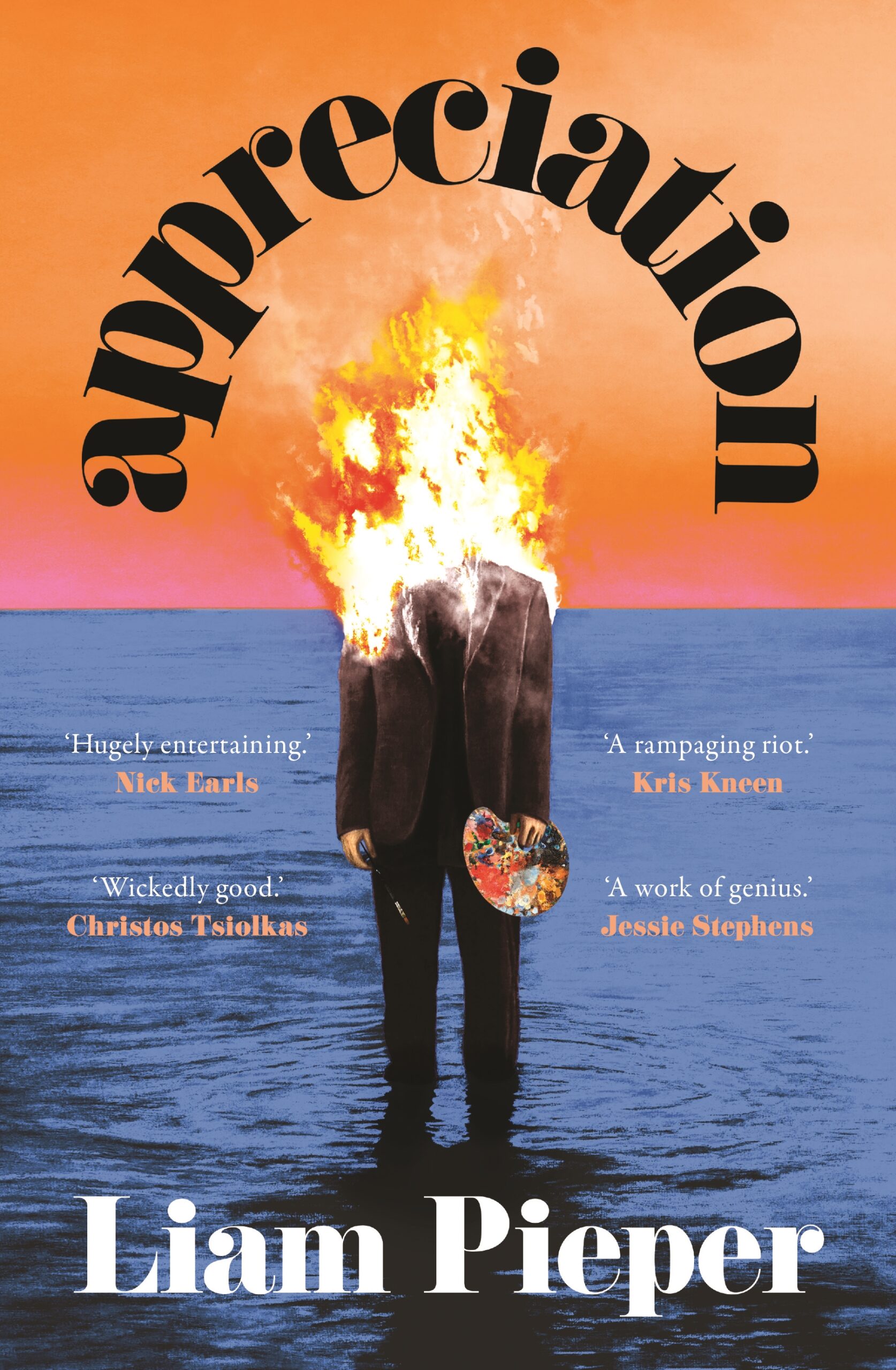
Pieper, Liam. Appreciation. Penguin, 2024.
RRP: $34.99, 368pp, ISBN: 9781760890193.
Timothy Loveday
Transgressive? Laughable.
In Kill All Normies, academic and nonfiction writer Angela Nagel writes that transgression has been embraced as a virtue within western social liberalism since the 1960s (2017 28). This, Nagel argues, poses a considerable threat to the artist, who is now charged with either performing transgression unconditionally, or else living in fear of being labelled a conservative. While this may well be an over-simplification of contemporary discourses on transgression, it is an idea—or dare I say an issue—at the crux of Liam Pieper’s novel Appreciation.
The novel is centred on Oli Darling, a queer artist from the country, who has made a career out of weaponising his identity in order to sell his subpar art. This is when we meet Oli: on the eve of a new sold-out exhibition, in the never-ending maelstrom of parties and appearances that apparently make up what it is to be a contemporary working artist in so-called Australia. Never-ending that is, until Oli is featured on a talk show (definitely not Q&A), where, strung out after a lack of sleep and still high on a morning bump of cocaine, he goes on one of his left political diatribes that he’s made a name for, inadvertently calling the Anzacs war criminals. For all intents and purposes, Oli is cancelled.
Appreciation seems to be part of a range of satirical books that look at the role of the contemporary artist under capitalism in Australia, works perhaps best represented through Bri Lee’s recent novel The Work and Ennis Ćehić’s 2022 short story collection Sadvertising. No doubt Pieper has woven his own professional and personal experiences into the seams of the novel—much like Lee and Ćehić before him—and what plays out might be described as a sort of meta tour de force, in which Pieper envisions the catastrophic reception Appreciation itself might receive.
Here, Pieper pulls few punches. He goes after everything from the corporatisation of art production to the supposed capitalisation of identity-markers. All the while, Pieper works hard to convince us to, in part, root for a profoundly unlikeable protagonist, who tests us against ourselves on almost every page.
Pieper’s assessment of the visual arts community is scathing, though it is not really an assessment of visual arts at all. As Pieper notes in the acknowledgements, he wrote the world he knew: writing. This is well-worn terrain for Pieper, having made a career as an author and ghost-writer, though it does beg the question as to why he didn’t just write Oli Darling as an established novelist.
One of the critiques that runs hot through Appreciation is a general frustration with superficial representations of self and ideas within the arts. This is likely most evident in Darling’s inability to speak with any real depth on toxic masculinity, despite arguing this is the focus of his recent collection. Further, the narrator (who, as we find out went to art school) seems unable to name any other queer artists beside David Hockney. In fact, in its staggering 351 pages, the novel makes only a handful of references to actual artists—and few, if any, who might be considered contemporary (the closest being Damien Hirst).
Likewise, Pieper approximates much of the arts world to stereotypes, such as ‘the Money’, ‘the Baron’, ‘the Scion’ and ‘the Paperman’—personalities within the arts who are again reduced to vampire-like characters when Pieper writes, ‘The people came to events like this for the proximity to youth and energy and creative spark’ (8). These caricatures work to heighten the stakes of the novel—as a unit, acting as a cultural villainy that speaks to the moral ambiguity in Australian art production—but they simultaneously and inadvertently highlight how often Appreciation seems to lack nuance and depth, reducing ideas and communities to approximations, summaries and diatribe-like asides. Because of this, Appreciation feels gestural rather than substantive in its critiques. Take this extract from chapter five for example:
The first, easiest interview is brunch at a Sydney pub, a once-bohemian haunt that grew so famous for its louche patrons and their long lunches that it was purchased by a rapacious hospitality conglomerate who refitted it and hired a team of chefs with gleaming Japanese-steel paring knives to carve the soul out of it. (18)
Nothing that Pieper says is wrong, it’s just that it largely feels ready-made and Instagram-able. This begs the question, in such a claustrophobic literary community, who exactly is Pieper speaking to? No doubt he’s aware that the vast majority of readers in Australia are either writers themselves or literary adjacent, and as such it seems odd that while this book spends so much time casting shade on the often superficial patterns of representation within Australian literary arts—not to mention the often questionable structures of money and power—he seems unaware that this work replicates the performance he sets out to critique.
There is, though, the alternative read, one in which the satire suspends itself outside of the work—a critique that is embodied. Is Pieper wholly aware of what he’s doing? Is the work a sort of metafictional piece, one in which the characters, plotlines and politics are artfully shallow, in order to speak to the supposed shallowness of the industry at large? This then, might be similar to how many came to understand R. F. Kuang’s Yellowface, another recent work, albeit American, that looks at the morality of art production as it pertains to identity. Or, is this a broader charge against the form of satire, itself? Is satire—as a form that uses humour as an agent of critique—naturally inclined toward a certain superficiality? I’d think not, especially considering the mass of literary satire that manages to tackle similar themes to those in Appreciation—namely themes of masculinity—with nuance, depth and laugh-out-loud absurdity. Books like Chuck Palahniuk’s Fight Club (1996), Julie Koh’s Portable Curiosities (2017), Wayne Marshall’s Shirl (2019) and Jackie Ess’s Darryl (2021), as well as the recent breakout success, Tony Tulathimutte’s Rejection (2024).
Regardless, my issue with Appreciation is that Pieper seems content to put a work forward that signals at every turn, reminding us time and again how the book is a good book and not a bad book. In this, Pieper’s work feels about as transgressive as Nike’s 1984 campaign, or Kendall Jenner’s 2017 collaboration with Pepsi—a performance aimed at selling itself, rather than bringing down the dictatorship.
Works Cited
Ćehić, Ennis. Sadvertising. Penguin, 2022.
Ess, Jackie. Darryl. New York: Clash Books, 2021.
Koh, Julie. Portable Curiosities. Brisbane: UQP, 2017.
Kuang, Rebecca F. Yellowface. Harper Collins, 2024.
Lee, Bri. The Work. Sydney: Allen & Unwin, 2024.
Marshall, Wayne. Shirl. South Melbourne: Affirm Press, 2019.
Nagel, Angela. Kill All Normies: online culture wars from 4chan and Tumblr to Trump and the Alt-Right. London: Zer0 Books, 2017.
Palahniuk, Chuck. Fight Club. New York: W. W. Norton & Company, 1996.
Tulathimutte, Tony. Rejection. London: 4th Estate, 2024.
Tim Loveday is a poet, writer and baby academic. His work explores class, masculinity, online radicalisation and climate collapse. He won the 2022 & 2024 Dorothy Porter Poetry Awards, the 2025 Calanthe Prize and the 2023 Venie Holmgren Environmental Poetry Award, came runner-up in the 2024 Cloncurry Poetry Prize and was a finalist in the 2023 David Harold Tribe Poetry Prize, the 2024 Griffith Review Emerging Voices Prize, the 2024 Best Australian Yarn, the 2024 Montreal International Poetry Prize and the 2025 Dorothy Hewett Prize. Tim teaches Creative Writing at Unimelb and RMIT. He is the incoming poetry editor at Island Magazine. Tim is currently completing a creative practice PhD at Unimelb, where his research focuses on satirical representations of the manosphere. More: timloveday.com.
Partners