Review of ‘The Hair of the Pigeon’ by Mohammed Massoud Morsi
Rashida Murphy
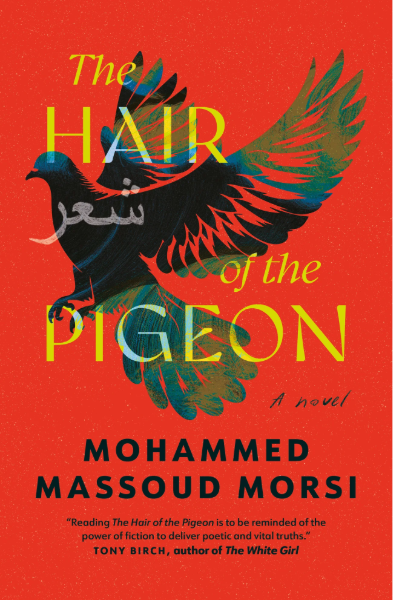
Morsi, Mohammed Massoud. The Hair of the Pigeon. Crawley: UWA Publishing, 2026. RRP: $34.99, 230pp, ISBN: 9781760803247.
The Hair of the Pigeon is Mohammed Massoud Morsi’s second novel set in the region referred to as the ‘Middle East’ but more accurately known as SWANA (South West Asia and North Africa). The novel won the Dorothy Hewett Award in 2025 and has since garnered rave reviews, translations and and an American edition along with this edition (published by UWA Publishing in early 2026).
Arriving seven years after Morsi’s debut novel The Palace of Angels (Wild Dingo Press, 2019), The Hair of the Pigeon returns the reader to the same devastated landscapes and peoples of Palestine, Syria and Lebanon. War, displacement, love and repair are recurrent themes in Morsi’s work, a consequence of a career spent as a photojournalist in Europe, Africa and Asia. In an interview with UWAP, Morsi acknowledges that, here in Australia, ‘we have the privilege of peace and a chance to consider lives different from our own’. He hopes his novel is ‘received in the manner in which it is given,’ and that there is a chance that a story about people living in a refugee camp in Syria can resonate with those who understand the struggles and injustices that make someone a refugee.
The Hair of the Pigeon follows the lives of primarily Palestinian refugees living in the Yarmouk Refugee Camp on the outskirts of Damascus in Syria. Ghassan (whose very name invokes Ghassan Kanafani, the Palestinian activist and author who was killed by Israel at the age of thirty-six), and his best friends Badawi and Sama, grow up in the confines of a crowded camp. Despite the brutalities of life as displaced people, Ghassan, Sama and Badawi test the bonds of friendship, love and hope in Yarmouk’s violent heart. Sama, the girl who raises pigeons on her roof and casually twists the necks of birds she loves, triggers a confrontation between Ghassan and Badawi. Just as Kanafani’s inspiration for writing was the idea that the Palestinian struggle for self-determination cannot be separate from the rest of the Arab world, Morsi, too, situates Palestine as crucial to any story that centres the Arab experience.
As a journalist documenting the horrors of occupied Gaza and a witness of Arab apathy as well as solidarity, Morsi is intimate with the choreography of Palestine’s tragedy. In his fiction, Morsi highlights narratives of grief but also joy and the reality of lives lived despite near-insurmountable loss. Sections of the book dealing with life in Yarmouk are portrayed through the poetics of displacement.
A lurking haze descended into the narrow cavities between the sand-coloured buildings. Slivers of sunbeam cut through dust and debris twirling upwards in small twisters of hot air. It was too hot to do anything until the sun set longer shadows. Then the street noises returned: the chatter, the sound of shutters rolling up, short honks from half-empty minivans, transistors tuning in to shortwave broadcasts, music—and laughter. There was always laughter. (10).
Morsi’s new novel takes its place alongside the works of other contemporary Arab writers in Australia such as Omar Sakr, Michael Mohammed Ahmed, Micaela Sahhar and Sara Saleh. Powerful stories of homelands under attack or at risk of erasure, and the social history of the Levant that is embedded in modern Australia’s food, clothing and language, remind us of the necessity of engaging with literature that brings discomfort, elucidation and sorrow in equal measure. This makes The Hair of the Pigeon a novel for the times we are living in, a reminder that life endures, that love triumphs, that sorrow is endemic to the human condition. Despite the brutality and cruelty imposed on those who live under siege, it is possible to hope and imagine better outcomes, and ultimately to realise that those lives are not so different from ours.
Rashida Murphy is a writer living in Boorloo. Her award-winning new work, Old Ghosts was released in August 2026 with Night Parrot Press. She runs The Writers’ Collective, mentors emerging writers and listens deeply when the cat speaks.
Partners